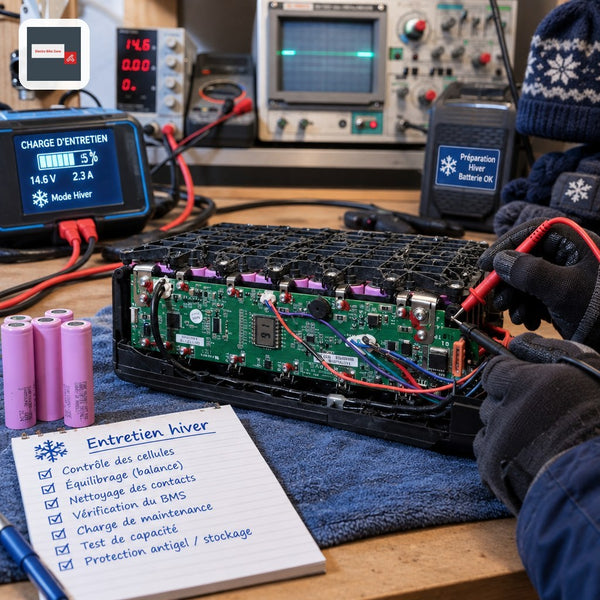
"Will my battery still go the distance?" It's a question we hear a lot in the workshop, especially as the days get shorter. A feeling that it's tiring out isn't enough to answer it: you need to measure. That's exactly what we do with Swiss Battery, our dedicated battery business in Prilly.
Measure, don't guess
As we explained in our last post, the battery is discharged on a tester. It shows its real capacity, expressed in mAh. We also check its electronics, the BMS, as well as its cells.
Once we know these three things, we know where the battery stands and what we can do for it. No more relying on gut feeling or on a fuel gauge that can't make up its mind.
The BMS and the cells in a nutshell
- The cells: this is where the energy is stored. Over time, they can wear out.
- The BMS: the electronics that monitor and manage the battery. It deserves a check just as much as the cells do.
- The capacity in mAh: the value measured during discharge, which gives a concrete picture of the battery's current condition.
Why do it before winter?
Our answer is simple: better to know the state of your battery in November than in the middle of the cold season. If you discover a problem in the depths of winter, you end up on foot, or without your bike just when you need it to get to work. With a diagnosis done in good time, you can make your decision calmly.
For anyone who rides an e-bike all year round, it's also a way of having peace of mind. Sustainable mobility works all the better when you can count on your equipment.
What if the battery is worn out?
According to the Swiss Battery page, the Prilly workshop replaces worn cells in e-bike batteries, as well as in e-scooter and power tool batteries. The process follows a precise order: diagnosis, clear quote, capacity test.
If your battery no longer holds its charge or no longer recharges, the page states that each group of cells is measured and the electronics checked. The principle: we replace "only what needs replacing", according to Swiss Battery. You keep your original casing, and the rebuilt battery is, according to that same page, often longer-lasting than when you bought it.
In practice, this means you don't throw away a whole battery when only part of it is at fault. It's more sensible for your wallet and for the environment.
What happens during the visit?
- You bring your battery to the workshop in Prilly.
- We measure it and check its electronics and cells.
- We explain the result in plain terms, without unnecessary jargon.
- You decide what to do next, knowing the real condition of your battery.
Our advice: don't wait for your battery to let you down. If you notice that it holds up less well than before, that it no longer charges as it used to, or if you simply want to know where you stand before the bad season, drop by the workshop. A check lets you know what to expect. And if you handle your battery yourself, be careful: opening a casing is a job for a specialist.
Our commitment to sustainable mobility
For us, helping an e-bike last longer is part of sustainable mobility. Measuring, explaining, repairing what needs repairing: that's what we enjoy doing in the workshop. If you have any questions about your battery, come and see us in Prilly: we'll take the time to answer them.
Want a service or some advice? Book an appointment online or drop in at our Prilly workshop.